Question
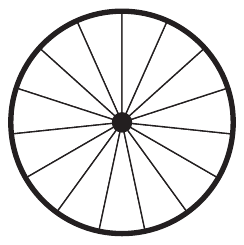
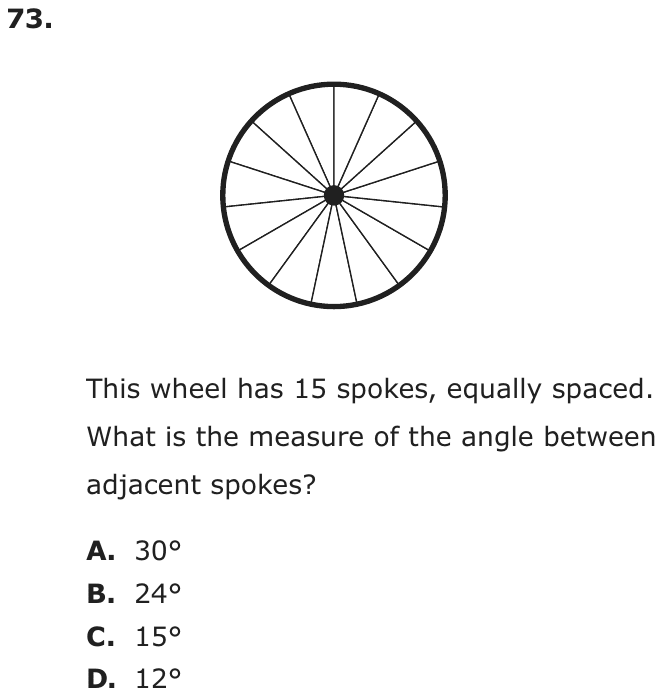
This wheel has 15 spokes, equally spaced. What is the measure of the angle between adjacent spokes?
- A30°
- B24°
- C15°
- D12°
Show the answer
Correct answer: B
The total number of degrees in a circle is 360. The measure of the angle between adjacent spokes is .
Question analysis
A wheel has 15 spokes, equally spaced around its hub, as the figure shows. Students find the measure of the angle between two neighboring spokes. The question tests knowing how many degrees make a full turn around a point and sharing them equally among the spokes.
- NYS standards
- 7.G.5 angle relationships and equations
- Grade level
- Grade 7 content, by NYS standard
- Compared with grade 7
- Below grade 7 Finding an angle by dividing a full turn into equal parts is early angle measurement. It takes one division, and the only fact needed is the number of degrees in a circle, so it sits below grade 7.
- Estimated difficulty
- Routine: one familiar step, little to misread.
- Thinking it demands
- Depth of knowledge 1, recall and reproduction · mainly apply
- What makes it hard
- Solution
- 1 step
- Reading level
- Question and choices: about grade 5, 16 words.
- Students, last 30 days
- Not enough answers yet to show (it takes 10).
Why it is hard, traps and wrong answers (shows the answer)
Why it is hard
One fact and one division answer this question, so it is among the easiest on the test. The wrong choices catch students who use a straight angle’s 180° for the full turn, who take the number of spokes as the angle, or who guess a familiar angle. Multiplying the answer by 15 to get back to 360° is a quick check.
Something you must already know minor Working it out
The question never says that a full turn is 360°; knowing it, and that the 15 spokes split it into 15 equal angles, is the whole method. (Anderson & Krathwohl, 2001)
Strategy: The spokes split the full turn around the hub into 15 equal angles, so divide the number of degrees in a circle by 15.
Traps
- Wrong formula: Uses a related but wrong formula: perimeter for area, diameter for radius, area for volume, or a misremembered one.
- Numbers taken from the question: Combines the numbers in the question without a model of the situation, or is simply a number that appears in the question.
The wrong answers, classified
A Little reason to choose it (Haladyna & Downing, 1993; Rodriguez, 2005)
No working with 15 spokes gives 30°, which is 360 ÷ 12, the angle between hours on a clock, so it mostly draws guesses at a familiar angle.
C Numbers taken from the question (Hegarty, Mayer & Monk, 1995)
Takes the number of spokes, 15, as the angle in degrees, matching a number in the question without any calculation.
D Wrong formula (King et al., 2004)
Divides 180 by 15, using a straight angle’s 180° as the full turn around the hub instead of 360°.
Worked solution, step by step
Formulas used
- Equal angles around a point
- One full turn around a point is 360 degrees. If lines from the point split that turn into equal angles, each angle gets the same share. So divide 360 by how many angles there are.
Sort out the question
The wheel has 15 spokes. They all start at the hub, the center of the wheel, and they are equally spaced. Adjacent spokes are spokes right next to each other. You need the angle between two adjacent spokes.
Count the angles around the hub
Go once around the hub. Between each spoke and the next is one angle. So 15 spokes make 15 angles, all the same size. Together they make one full turn, which is 360 degrees.
Watch out: a full turn is 360 degrees, not 180. Using 180 gives 12 degrees, choice D.
Share the full turn
Use the formula for equal angles.
Each angle is 24 degrees. Watch out: 15 is the number of spokes, not the size of the angle, so choice C is wrong. So the answer is B, 24°.
Check your answer
Multiply back: 15 angles of 24 degrees make degrees, a full turn. Also, a clock’s 12 hour marks are 30 degrees apart. This wheel has more spokes than that, so each angle must be smaller than 30 degrees.
More questions like this
The original DOE question