Passage Excerpt from “The Food Business Incubator”
Excerpt from “The Food Business Incubator”
by Mandalit Del Barco
“La Cocina” means “the kitchen” in Spanish. It’s also the name of a business incubator1 based in San Francisco’s Mission District. Since it began in 2005, it’s been helping local food entrepreneurs, many of whom are low-income immigrant women, develop their small businesses.
Over the years, many of its alumni have found success: more than 50 chefs in its program have become self-sufficient business owners, and many of them have opened their own brick-and-mortar restaurants. Two alumnae of its culinary program . . . were even recognized as semi-finalists for prestigious James Beard awards.2
A new cookbook, We Are La Cocina: Recipes in Pursuit of the American Dream, tells some of their stories.
Executive director Caleb Zigas says the nonprofit La Cocina grew out of two grassroots economic development organizations3 who found many people cooking at their homes and selling food on the streets. The vendors needed an affordable commercial kitchen space and technical assistance in order for their businesses to be legally viable. La Cocina provided just such a space, in addition to helping them develop business plans, pull city permits and more.
Zigas says as many as eight businesses can work in the kitchen space at La Cocina at any one time. Some can prep for a farmers’ market sale, corporate catering gigs or weddings, while others might be making and packaging their food products.
“It’s just an incredible and exciting range of techniques, flavors, perspectives, age, language. And that’s a really beautiful thing,” he says. . . .
Twice a year, La Cocina hosts “F&B: Voices from the Kitchen,” a storytelling project where their chefs can tell their own stories, as they do in the new cookbook. Some of the chefs will be on tour to promote the book, whose proceeds will go to support La Cocina entrepreneurs.
NPR4 caught up with . . . La Cocina chefs, who shared their stories:
Mariko Grady, Aedan Fermented Foods
At La Cocina, you can often hear Mariko Grady singing or humming as she prepares miso, koji, and amasake. Her fermented products come in four different flavors, including mushroom and chicken, to be used in soups and sauces. She originally brought the fermenting rice and barley koji seeds from Japan, where she had a 30-year career as a singer and dancer with the prestigious modern theatrical dance group she founded, Pappa Tarahumara. They performed around the world, and 16 years ago, had a one-night show in San Francisco. The man who would become her husband was in the audience. She soon joined him in San Francisco, often returning to Tokyo to rehearse. But after the earthquake and tsunami hit Japan in 2011, her company disbanded. . . . Grady focused on nourishing her family and creating a line of fermented products that she sells online, at local Bay Area stores and at the Ferry Plaza Farmers Market. She began at La Cocina in 2012 and named her business after her son, Aedan. (Written in Kanji characters, the name means “wisdom” and “handed down from generation to generation.”) . . . Her fermented products are “also full of wisdom about how to relate to nature and how to create a healthy life,” she says. . . .
Shani Jones, Peaches Patties
Shani Jones is a native San Franciscan. Her father was born in New Orleans, her mother, in Jamaica. She says their home was always filled with a variety of spices and dishes like jerk chicken and Jamaican patties—savory pastries filled with beef or chicken. Jones says she learned to cook from her mother, whose nickname was Peaches. After returning from college in Atlanta, Jones worked on her doctorate in organizational leadership and management while driving a Lyft5 car. She often told passengers about her idea of opening a catering company with her mom’s recipes. They steered her to La Cocina, where she developed her own business, named after her mother. Five years later, she caters and runs a kiosk6 at a small food cooperative in Bernal Heights, where some of her handmade patties have an Ethiopian twist, “because my husband is Ethiopian.” Jones has big aspirations for Peaches Patties: “The ultimate goal,” she says, “is to be the patty kingpin7 of the West Coast.”
From “The Food Business Incubator That Helps Immigrant Women Pursue The American Dream” by Mandalit Del Barco from WEEKEND EDITION SUNDAY, June 19, 2019. Copyright © 2019 NPR.
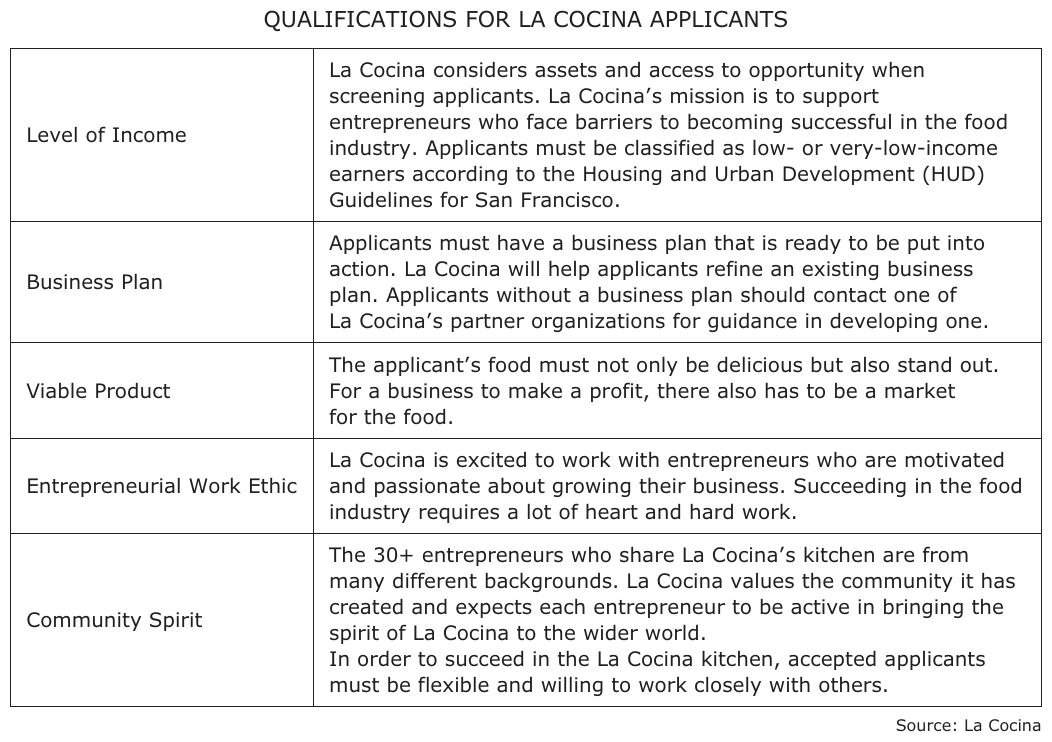
QUALIFICATIONS FOR LA COCINA APPLICANTS
| Level of Income | La Cocina considers assets and access to opportunity when screening applicants. La Cocina’s mission is to support entrepreneurs who face barriers to becoming successful in the food industry. Applicants must be classified as low- or very-low-income earners according to the Housing and Urban Development (HUD) Guidelines for San Francisco. |
|---|---|
| Business Plan | Applicants must have a business plan that is ready to be put into action. La Cocina will help applicants refine an existing business plan. Applicants without a business plan should contact one of La Cocina’s partner organizations for guidance in developing one. |
| Viable Product | The applicant’s food must not only be delicious but also stand out. For a business to make a profit, there also has to be a market for the food. |
| Entrepreneurial Work Ethic | La Cocina is excited to work with entrepreneurs who are motivated and passionate about growing their business. Succeeding in the food industry requires a lot of heart and hard work. |
| Community Spirit | The 30+ entrepreneurs who share La Cocina’s kitchen are from many different backgrounds. La Cocina values the community it has created and expects each entrepreneur to be active in bringing the spirit of La Cocina to the wider world. In order to succeed in the La Cocina kitchen, accepted applicants must be flexible and willing to work closely with others. |
Source: La Cocina
1business incubator: company that helps new and startup companies develop by providing services such as management training and office space
2James Beard awards: an award named after American cook and author James Beard, considered one of the highest honors in the culinary industry
3economic development organizations: organizations whose mission is to promote economic improvement within a specific geographical area
4NPR: National Public Radio, a nonprofit media organization that produces and distributes news and cultural programming
5Lyft: ride-sharing company where people use their own cars to provide rides to customers
6kiosk: cart or small structure with one or more open sides that is used to vend merchandise or services
7kingpin: the leader in a group or undertaking
Question
The quotation from Caleb Zigas in paragraph 6 conveys a central idea of the excerpt by
- Ashowing appreciation for the vibrant diversity of La Cocina.
- Bcommunicating La Cocina’s goal of helping people of varying abilities.
- Cdescribing a typical scenario at La Cocina.
- Demphasizing La Cocina’s focus on creating products.
Show the answer
Correct answer: A
The question asks how the quotation from Caleb Zigas in paragraph 6 conveys a central idea of the excerpt.
A. CORRECT. A central idea of the excerpt is that La Cocina’s entrepreneurs are a group of people cooking a diverse range of cuisines. This quotation from the executive director of La Cocina conveys this idea by emphasizing the diversity of both the cooking methods and the chefs themselves.
B. Incorrect. While La Cocina’s goal is “helping local food entrepreneurs, many of whom are low-income immigrant women” (paragraph 1), the organization does not necessarily have a goal of helping people without solid cooking skills. Per the table that describes the “Qualifications for La Cocina Applicants,” the applicant’s food must be delicious, which speaks to the skill required for all participants.
C. Incorrect. The quotation describes the diversity of people and cooking techniques found at La Cocina, but it does not reference “a typical scenario.” Paragraphs 9 and 10 more closely describe examples of typical La Cocina chef entrepreneurs.
D. Incorrect. Applicants to La Cocina must have a food that is a “viable product,” but this quotation emphasizes the diversity of chefs and cuisines, not the requirements chefs must meet to enter the program.
Question analysis
This question looks at paragraph 6 of the La Cocina article, a two-sentence quotation in which executive director Caleb Zigas sums up what he sees at the nonprofit. Students must decide how the quotation conveys a central idea of the excerpt, which means restating Zigas’s words in their own and connecting them to the article as a whole.
- Grade level
- Grade 7 reading and task
- Compared with grade 7
- Below grade 7 Showing how a quotation supports a central idea is grade 6 and 7 work. This quotation is two sentences in everyday words, and its meaning sits close to the surface, so the demand is lighter than typical grade 7 reading.
- Estimated difficulty
- Straightforward: two steps or one careful reading.
- Thinking it demands
- Depth of knowledge 2, skills and concepts · mainly analyze
- What makes it hard
- Reading between the lines minor
- How, not what minor
- Evidence
- Answered from one paragraph or stanza
- Reading level
- Passage: about grade 10, 1057 words; question and choices: about grade 12, 48 words.
- Students, last 30 days
- Not enough answers yet to show (it takes 10).
Why it is hard, traps and wrong answers (shows the answer)
Why it is hard
The quotation is short and warm, and most students hear its enthusiasm for variety at once. The wrong choices come from reading it with paragraph 5 still in mind, a kitchen busy with market and catering prep and with food products being packaged, or from turning a range of cooking styles into a range of skill. Students who restate the quotation in their own words before reading the choices avoid all three.
Reading between the lines minor Working it out
Zigas never says “diversity”; students must see that his list, “techniques, flavors, perspectives, age, language,” describes variety among the cooks and their food, and that “a really beautiful thing” expresses appreciation. (Graesser, Singer & Trabasso, 1994; Kintsch, 1998)
How, not what minor Working it out
The stem asks how the quotation conveys a central idea, so students must name what Zigas’s words do for the excerpt, not just what they say, and link them to the mix of chefs profiled later. (Anderson & Krathwohl, 2001)
Strategy: Reread the quotation and say in your own words what Zigas finds exciting; then choose the option that matches your words and also fits the rest of the article.
Traps
- Wrong part of the text: A choice is true of another paragraph, stanza or speaker than the one asked about.
- Twists what the text says: Uses the text's topic and ideas but changes what it says: who did it, how much, when, or why.
The wrong answers, classified
B Twists what the text says (King et al., 2004)
Turns Zigas’s “range of techniques” and “age” into people of differing ability, though he celebrates variety in cooking styles and backgrounds, and the table requires every applicant’s food to be delicious.
C Wrong part of the text (Kirsch & Mosenthal, 1990)
Carries paragraph 5’s scene, eight businesses prepping for markets, catering and weddings, into the quotation, which describes no typical scenario but sums up the variety Zigas sees.
D Twists what the text says (King et al., 2004)
Links “flavors” and “techniques” to the packaged food products of paragraph 5 and makes products the point, though Zigas is praising the mix of people and cooking styles.
Working it out, step by step
Know what a central idea is
A central idea is an important idea that runs through a whole text. This question asks how one quotation from Caleb Zigas, the head of La Cocina, shows a central idea. Start by putting his words into your own.
Read the quotation in paragraph 6
Zigas says, “It’s just an incredible and exciting range of techniques, flavors, perspectives, age, language.” A range is a wide mix. Techniques are ways of cooking. Perspectives are ways of seeing the world. Then he adds, “And that’s a really beautiful thing.”
Say it in your own words
In plain words, Zigas loves how different everyone at La Cocina is. The cooks are young and old. They speak different languages. They cook in different ways and make food with different flavors. He calls this mix “beautiful,” so he is praising it. A word for this kind of mix is diversity. The chef stories show it too. Mariko Grady brought her koji seeds from Japan. Shani Jones gives some patties an Ethiopian twist.
Check each choice
- A is right. Vibrant means lively and full of energy. Zigas shows appreciation, or praise, for the lively mix of people and foods.
- B is wrong. A range of cooking styles is not a range of skill. The table says every applicant’s food “must not only be delicious but also stand out.”
- C is wrong. The busy kitchen scene is in paragraph 5. The quotation sums up a feeling. It doesn’t describe a usual day.
- D is wrong. Zigas is praising people and styles, not products for sale.
Choose the answer
The quotation praises the wide mix of people and cooking at La Cocina, an idea the chef stories also show. So the answer is A.
Why this answer and not the closest wrong one
B is the closest wrong answer, because Zigas does mention “age” and “techniques.” But he is talking about variety, not about how good the cooks are. A matches both halves of his quotation: the mix of people and food, and the word “beautiful.”
More questions like this
The original DOE question

The passage “Excerpt from “The Food Business Incubator”” as printed (pages 158–160)