Question
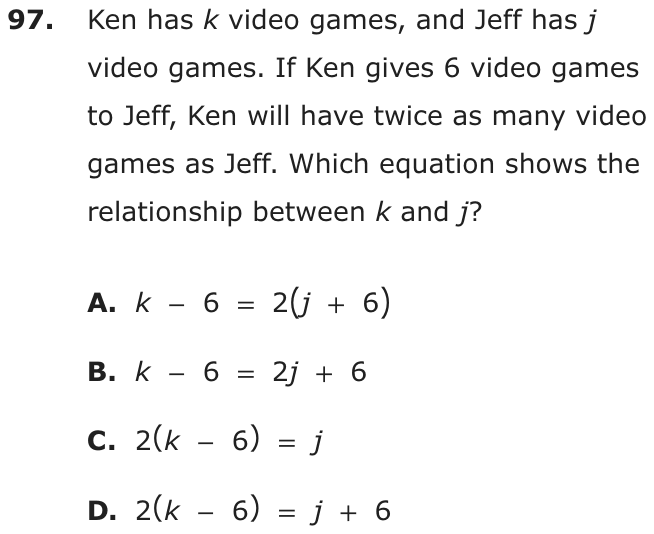
Ken has k video games, and Jeff has j video games. If Ken gives 6 video games to Jeff, Ken will have twice as many video games as Jeff. Which equation shows the relationship between k and j?
- A
- B
- C
- D
Show the answer
Correct answer: A
If Ken gives 6 video games to Jeff, the number Ken has is , and the number Jeff has is . After the exchange, Ken has twice as many video games as Jeff. The equation is:
Question analysis
This algebra word problem says Ken has k video games and Jeff has j, and if Ken gives Jeff 6 games, Ken will have twice as many as Jeff. Students choose the equation that models the situation. Getting the comparison the right way round, and grouping each new total correctly, is where most errors happen.
- Grade level
- Grade 7 content, by NYS standard
- Compared with grade 7
- At grade 7 Grade 7 students write equations from word problems. This one tracks two people's counts after a transfer and states a times-as-many comparison, so both counts change and the factor of 2 must go on the right side: typical but error-prone.
- Estimated difficulty
- Moderate: several steps, or a close reading with one strong distractor.
- Thinking it demands
- Depth of knowledge 2, skills and concepts · mainly apply
- What makes it hard
- Turning words into math moderate
- A very close wrong answer moderate
- Variables instead of numbers minor
- Solution
- 2 steps
- Reading level
- Question and choices: about grade 4, 41 words.
- Students, last 30 days
- Not enough answers yet to show (it takes 10).
Why it is hard, traps and wrong answers (shows the answer)
Why it is hard
The question is all setup: no solving is needed, just an equation that says what the story says. The trade moves games out of one count and into the other, and the comparison has to be written with the 2 on the smaller side. The wrong equations reverse the comparison, forget Jeff's gain, or drop the parentheses, and all four look alike. Plugging in sample counts is the surest check.
Turning words into math moderate Understanding the question
After the gift both counts change, Ken's to k − 6 and Jeff's to j + 6, and “twice as many video games as Jeff” must double Jeff's whole new count, putting the 2 on his side. (Hegarty, Mayer & Monk, 1995; Koedinger & Nathan, 2004)
A very close wrong answer moderate Choosing the answer
All four equations share the pieces k − 6, j + 6 and a 2; the right one differs from 2(k − 6) = j + 6 only in where the 2 sits, and from k − 6 = 2j + 6 by parentheses. (Embretson & Wetzel, 1987; Gorin & Embretson, 2006; Ascalon et al., 2007)
Variables instead of numbers minor Understanding the question
There are no numbers to check against, only k and j, so testing an equation means inventing counts that fit the story, such as Jeff with 4 games and Ken with 26. (Koedinger & Nathan, 2004; Enright, Morley & Sheehan, 2002)
Strategy: Write each boy's number of games after the exchange as an expression, then translate "Ken will have twice as many as Jeff" into an equation and test it with sample numbers.
Traps
- Equation written backwards: Writes a comparison the wrong way round, word for word: "six times as many students as professors" as 6S = P. The bigger quantity gets the bigger number.
- Order of operations: Working left to right, or distributing a minus sign wrongly, gives a choice.
The wrong answers, classified
B Order of operations (Brown & Burton, 1978)
Leaves out the parentheses, doubling only Jeff's old count j and then adding 6, instead of doubling his whole new count j + 6.
C Equation written backwards (Clement, Lochhead & Monk, 1981)
Puts the 2 on Ken's side, writing the comparison backwards, and also forgets that Jeff gains the 6 games, two errors in one equation.
D Equation written backwards (Clement, Lochhead & Monk, 1981)
Writes the comparison backwards word for word, doubling Ken's new count, which would mean Jeff ends with twice as many games as Ken.
Worked solution, step by step
Formulas used
- Twice as many
- A and B are two amounts. “A has twice as many as B” means A equals 2 times B. The 2 goes with the smaller amount, because that is the one you double to match the bigger one.
- The distributive property
- a, b and c are numbers. Multiplying a by a sum means multiplying a by each part, then adding. For example, 2(4 + 6) = 8 + 12 = 20.
Sort out the question
Ken has k video games, and Jeff has j. Then Ken gives 6 of his games to Jeff. After that, Ken has twice as many games as Jeff. You need the equation that links k and j.
Write each new amount
Ken gives away 6 games, so he has k − 6 left. Jeff gets those 6 games, so he has j + 6. Both amounts change, so use both new amounts.
Write “twice as many”
After the gift, Ken has more games. So Jeff’s new amount is the one that gets doubled.
Watch out: putting the 2 on Ken’s side, as in , would mean Jeff has twice as many. That is choice D.
Keep the parentheses
Twice Jeff’s new amount is 2j + 12, not 2j + 6. Watch out: dropping the parentheses gives choice B. So the answer is A, .
Check your answer
Make up numbers that fit the story. Say Jeff has 4 games and Ken has 26. After the gift, Ken has 20 and Jeff has 10, and 20 is twice 10. Choice A gives , or 20 = 20. Choice B gives 20 = 14, which is false.
More questions like this
The original DOE question