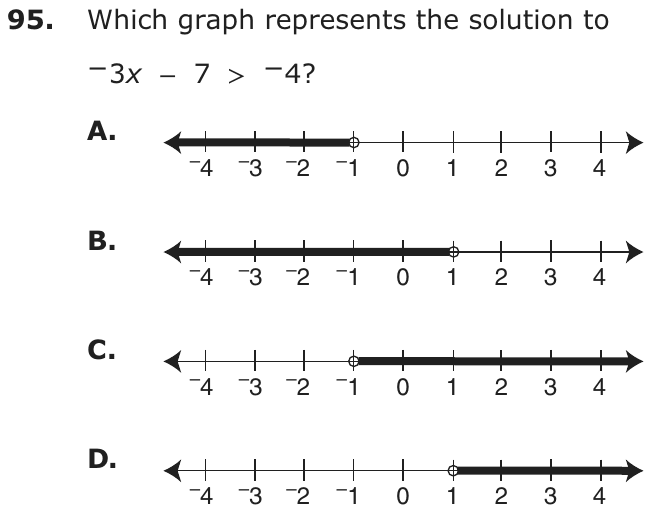
Question
Which graph represents the solution to ?
- A

- B

- C

- D

Show the answer
Correct answer: A
| Apply the additive inverse property; add 7 to both sides of the inequality. | |
| Apply the multiplicative inverse property; divide both sides of the inequality by −3. Note: when dividing an inequality by a negative number, the inequality sign is reversed. | |
The solution is that x is less than −1, so choose the graph that starts at −1 and continues to the left.
Question analysis
This inequality question asks which number line graph shows the solution of −3x − 7 > −4. Students solve a two-step inequality whose x term has a negative coefficient, then match the boundary point and the direction of the shading. Handling the inequality symbol at the division step is where most mistakes happen, and each slip has a matching graph.
- Grade level
- Grade 7 content, by NYS standard
- Compared with grade 7
- At grade 7 Solving and graphing a two-step inequality is a core grade 7 standard. This one has a negative coefficient on x, the classic grade 7 inequality trap, and four similar graphs test whether the sign and the direction were both handled.
- Estimated difficulty
- Moderate: several steps, or a close reading with one strong distractor.
- Thinking it demands
- Depth of knowledge 1, recall and reproduction · mainly apply
- What makes it hard
- Something you must already know moderate
- A very close wrong answer moderate
- Reading a figure, table or graph minor
- Solution
- 3 steps
- Reading level
- Question and choices: about grade 9, 7 words.
- Corrected from the DOE handbook
- A wrong term in the explanation was corrected.
- Students, last 30 days
- Not enough answers yet to show (it takes 10).
Why it is hard, traps and wrong answers (shows the answer)
Why it is hard
The solving takes two moves, but the second carries the rule the question tests: dividing an inequality by a negative number flips its direction. The four graphs cross two features, boundary at −1 or 1 and shading left or right, so forgetting the flip, dropping a sign, or both each land on a graph. Testing a shaded value such as x = −2 in the original inequality, where 6 − 7 = −1 is greater than −4, confirms the choice.
Something you must already know moderate Working it out
The step that decides the question, reversing the symbol when dividing both sides by −3, is a rule students must bring themselves; −3x > 3 becomes x < −1, not x > −1. (Anderson & Krathwohl, 2001)
A very close wrong answer moderate Choosing the answer
The graph shaded to the right from an open circle at −1 matches the right graph's boundary exactly and differs only in direction, the result of skipping the reversal. (Embretson & Wetzel, 1987; Gorin & Embretson, 2006; Ascalon et al., 2007)
Reading a figure, table or graph minor Understanding the question
Each graph must be read for two things, where its open circle sits, at −1 or 1, and which way the arrow runs, so a boundary alone does not identify the answer. (Lesh, Post & Behr, 1987; Kirsch & Mosenthal, 1990)
Strategy: Add 7 to both sides, divide by −3 and reverse the inequality symbol, then match both the boundary point and the shading direction; test one shaded value in the original.
Traps
- Negatives and direction: Arithmetic with negative numbers, the order of a subtraction, or direction on a number line. (Moving a term across the equals sign without changing its sign is a faulty procedure.)
The wrong answers, classified
B Negatives and direction (Brown & Burton, 1978)
Reverses the symbol correctly but drops the negative in 3 ÷ (−3), so the boundary lands at 1 with the shading to its left.
C Negatives and direction (Brown & Burton, 1978)
Divides both sides by −3 without reversing the symbol, solving the inequality as if it were an equation, so x > −1 and the shading runs right.
D Negatives and direction (Brown & Burton, 1978)
Treats −3x as 3x, so it solves 3x > 3 to get x > 1 with no reversal, which puts both the boundary and the direction wrong.
What was corrected from the DOE handbook, and why
- Explanation: The handbook’s steps say “add 7 to both sides of the equation” and “divide both sides of the equation by −3” (p. 142, question 95). But −3x − 7 > −4 is an inequality, not an equation, and the step’s own note is the point of the question: dividing an inequality by a negative number reverses the sign. The site now says “both sides of the inequality” in both steps, as the DOE’s later guides word this step (“Subtract 4 from both sides of the inequality” in the 2024–2025 guide). The working and the answer are unchanged.
Worked solution, step by step
Formulas used
- Adding to both sides of an inequality
- a and b are the two sides, and c is any number. Adding the same amount to both sides keeps the comparison true, like adding the same weight to both pans of a scale.
- Dividing an inequality by a negative number
- a and b are the two sides, and c is a negative number. When you divide both sides by a negative number, the greater-than sign flips to less-than. That is because negatives reverse order: 2 is more than 1, but −2 is less than −1.
Sort out the question
An inequality compares two amounts. The sign > means is greater than. You need the graph of every x that makes true. The graphs differ in two ways: where the open circle sits, at −1 or 1, and which way the shading goes.
Add 7 to both sides
Adding 7 undoes the −7, so the x term is alone on the left.
Divide by −3 and flip the sign
So x is any number less than −1. Watch out: if you forget to flip the sign, you get x > −1, and that graph is choice C. Also, 3 ÷ (−3) is −1, not 1. Dropping that minus sign leads to B or D.
Match the solution to a graph
Less than −1 means to the left of −1 on the number line. The circle at −1 is open, or empty, because −1 itself does not work. The sign means greater than, not greater than or equal to.
Graph A has an open circle at −1 and is shaded to the left. So the answer is A, the graph shaded left from an open circle at −1.
Check your answer
Test a number on each side of −1. For x = −2: , and −1 is greater than −4, so −2 works. For x = 0: , and −7 is less than −4, so 0 does not work. The shading must go left.
More questions like this
The original DOE question