Question
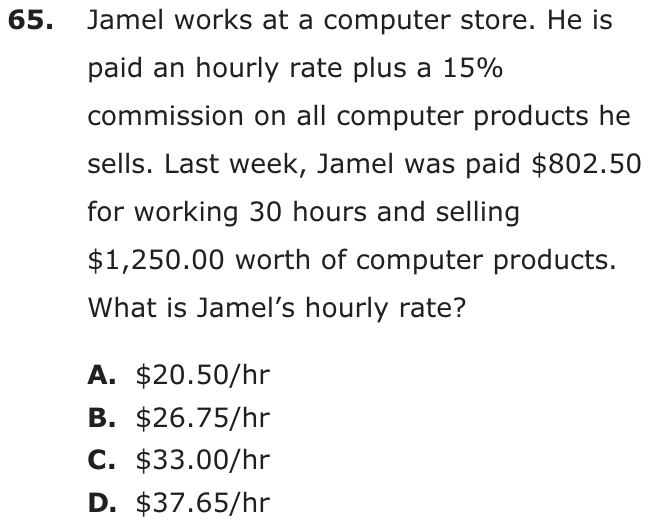
Jamel works at a computer store. He is paid an hourly rate plus a 15% commission on all computer products he sells. Last week, Jamel was paid $802.50 for working 30 hours and selling $1,250.00 worth of computer products. What is Jamel’s hourly rate?
- A$20.50/hr
- B$26.75/hr
- C$33.00/hr
- D$37.65/hr
Show the answer
Correct answer: A
First, determine the amount of Jamel’s weekly pay that is from commission:
Next, subtract Jamel’s commission amount from his weekly pay:
Last, divide the result by 30 hours to find Jamel’s hourly rate:
Question analysis
Jamel earns an hourly wage plus a 15% commission on his sales, and one week he is paid $802.50 for 30 hours of work and $1,250 in sales. Students find his hourly rate. The question mixes a percent with a rate, and the commission has to be taken out of the total pay before dividing by the hours.
- Grade level
- Grade 7 content, by NYS standard
- Compared with grade 7
- At grade 7 Commission is one of the percent applications named in the grade 7 standards, and the remaining work is a two-step equation with decimals. That matches a typical grade 7 multistep problem, with the order of the steps as the main demand.
- Estimated difficulty
- Moderate: several steps, or a close reading with one strong distractor.
- Thinking it demands
- Depth of knowledge 2, skills and concepts · mainly apply
- What makes it hard
- Turning words into math moderate
- Many steps moderate
- Error-prone arithmetic minor
- Solution
- 3 steps
- Reading level
- Question and choices: about grade 3, 44 words.
- Students, last 30 days
- Not enough answers yet to show (it takes 10).
Why it is hard, traps and wrong answers (shows the answer)
Why it is hard
Jamel's pay has two parts, and the question asks for only one of them, so the commission has to be removed before dividing by the hours. Students who divide the whole $802.50 by 30 get a believable hourly figure that still contains the commission. Checking the answer against the story, 30 × $20.50 + $187.50 = $802.50, confirms both parts.
Turning words into math moderate Understanding the question
The phrase "paid an hourly rate plus a 15% commission on all computer products he sells" makes $802.50 the sum of two parts, 30 hours of pay and 15% of $1,250. (Hegarty, Mayer & Monk, 1995; Koedinger & Nathan, 2004)
Many steps moderate Working it out
Three operations in order: 15% of $1,250 is $187.50, $802.50 − $187.50 = $615.00, and $615.00 ÷ 30 = $20.50; dividing before subtracting gives a listed choice. (Daniel & Embretson, 2010; Enright, Morley & Sheehan, 2002)
Error-prone arithmetic minor Working it out
Every amount carries cents, and 15% of $1,250 and $615 ÷ 30 are worked by hand, so a misplaced decimal point shifts the hourly rate. (Brown & Burton, 1978; Junker & Sijtsma, 2001)
Strategy: Take 15% of the $1,250 in sales to find the commission, remove that from the week's pay, and divide what is left by the 30 hours worked.
Traps
- Answers a different question: A choice is right for another quantity: the other unknown, the rest instead of the part, the part instead of the whole.
- Follows a key word: Picks the operation from a single word rather than the situation: "removed" so subtract, "of" so multiply, "more" so add, when the situation needs something else.
- Misreads the question: Misses or misreads a condition or a word in the question: "at least", "each", "remaining", "not".
The wrong answers, classified
B Answers a different question (King et al., 2004; Hegarty, Mayer & Monk, 1995)
Divides the whole $802.50 by 30 hours, which gives Jamel's average pay per hour with the commission included, not his hourly rate.
C Follows a key word (Hegarty, Mayer & Monk, 1995)
Follows the word plus and adds the $187.50 commission to the $802.50 instead of removing it, so (802.50 + 187.50) ÷ 30 = $33.00.
D Misreads the question (Hegarty, Mayer & Monk, 1995)
Swaps the two dollar amounts, taking 15% of the $802.50 pay and subtracting it from the $1,250 of sales: (1,250 − 120.38) ÷ 30 ≈ $37.65.
Worked solution, step by step
Formulas used
- Percent of a number
- p is the percent. The whole is the amount you take the percent of. The part is the result. Percent means out of 100. So 15% is 15 out of every 100, or 0.15.
- Pay with commission
- The rate is the money Jamel earns for each hour. Hours is how long he worked. The commission is extra money that is a percent of what he sells. His pay is these two amounts added together.
Sort out the question
Jamel’s pay has two parts. One part is an hourly rate, the money he earns for each hour. The other part is a commission. A commission is extra pay that is a percent of what he sells. He worked 30 hours and sold $1,250.00 of products. In all he got $802.50. You need his hourly rate.
Find the commission
His commission is 15% of what he sold. 15% means 15 out of 100, or 0.15.
His commission was $187.50. Watch out: take 15% of the $1,250 he sold, not of his $802.50 pay. Mixing them up leads to $37.65, choice D.
Take the commission out of his pay
The rest of his pay came from his hours.
He earned $615.00 for 30 hours of work. Watch out: the word plus does not mean add here. Adding the $187.50 to $802.50 counts the commission twice. That leads to $33.00, choice C.
Divide by the hours he worked
Share the $615.00 equally over the 30 hours.
Watch out: don’t divide all $802.50 by 30. That gives $26.75, choice B. That amount still includes the commission. So the answer is A, $20.50 per hour.
Check your answer
Work forward from the answer. 30 hours at $20.50 is dollars. Add the commission: . That is exactly Jamel’s pay for the week.
More questions like this
The original DOE question