Question
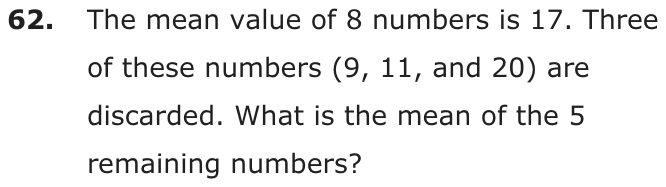
The mean value of 8 numbers is 17. Three of these numbers (9, 11, and 20) are discarded. What is the mean of the 5 remaining numbers?
Grid-in question: work out the answer and enter it as a number.
Show the answer
Correct answer: 19.2
First, find the sum of the original 8 numbers. Let x equal the sum of those numbers and use the mean formula to solve for x:
Next, subtract the 3 discarded numbers from the sum:
Finally, calculate the mean of the remaining 5 numbers by dividing the new sum, 96, by 5:
Question analysis
Eight numbers have a mean of 17, and three of them, 9, 11 and 20, are removed. This statistics grid-in asks for the mean of the five numbers that are left. Students have to rebuild the total from the mean before removing anything, and then divide by the new count rather than the old one.
- Grade level
- Grade 6 content, by NYS standard
- Compared with grade 7
- At grade 7 Finding a mean is grade 6 content, but working back from a mean to a total, removing values and averaging again is a typical grade 7 multistep task. As a grid-in, it offers no choices to check a wrong total against.
- Estimated difficulty
- Moderate: several steps, or a close reading with one strong distractor.
- Thinking it demands
- Depth of knowledge 2, skills and concepts · mainly apply
- What makes it hard
- Many steps moderate
- Much to keep track of minor
- An answer in an unexpected form minor
- Solution
- 3 steps
- Reading level
- Question and choices: about grade 3, 21 words.
- Students, last 30 days
- Not enough answers yet to show (it takes 10).
Why it is hard, traps and wrong answers (shows the answer)
Why it is hard
A mean cannot be adjusted directly when numbers are removed, so the question rewards switching from the mean to the total and back. The removed numbers, 9, 11 and 20, average less than 17, so the new mean must rise above 17; that quick check rules out an answer such as 12. Points are lost by dividing by the wrong count or by stopping at the new total.
Many steps moderate Working it out
Three operations come in a fixed order: multiply the mean by 8 to get 136, subtract 9, 11 and 20 to leave 96, then divide by the numbers that remain. (Daniel & Embretson, 2010; Enright, Morley & Sheehan, 2002)
Much to keep track of minor Working it out
The count changes partway through, from 8 numbers to 5, and the divisor at the end must be the new count, not the 8 from the first sentence. (Sweller, 1988; Carpenter, Just & Shell, 1990)
An answer in an unexpected form minor Choosing the answer
The answer, 19.2, is a decimal that must be gridded with its point, and with no choices a total of 96 or a mean over 8 numbers looks complete. (Enright, Morley & Sheehan, 2002)
Strategy: Turn the mean into a total by multiplying by 8, subtract the three discarded numbers, and divide what is left by the count of numbers that remain.
Traps
- Misreads the question: Misses or misreads a condition or a word in the question: "at least", "each", "remaining", "not".
- Stops one step early: A choice is a number from partway through the solution.
The wrong answers, classified
12 Misreads the question (Hegarty, Mayer & Monk, 1995)
Finds the remaining total, 136 − 40 = 96, correctly but divides it by the original 8 numbers instead of the 5 that are left.
96 Stops one step early (King et al., 2004; Gierl et al., 2017)
Subtracts the three discarded numbers from the total of 136 and grids the new sum, 96, without dividing by the 5 numbers left.
27.2 Misreads the question (Hegarty, Mayer & Monk, 1995)
Turns the mean into the total, 136, and divides it by 5 without first subtracting the three discarded numbers, 9, 11 and 20.
Worked solution, step by step
Formulas used
- Mean, or average
- The mean is the average. The sum is what you get when you add all the numbers. Divide it by how many numbers there are. The mean is the value each number would have if the total were shared out equally.
- Sum from a mean
- This is the mean formula turned around. If you know the mean and how many numbers there are, multiply them to get the sum. It works even when you don’t know the numbers themselves.
Sort out the question
There are 8 numbers. Their mean, or average, is 17. You don’t know what the 8 numbers are. Three of them, 9, 11 and 20, are discarded, or thrown away. That leaves 5 numbers. You need the mean of those 5 numbers.
Find the sum of all 8 numbers
You can’t add the 8 numbers, because you don’t know them. But the mean tells you their sum.
The 8 numbers add up to 136.
Take away the three discarded numbers
Subtract the three numbers that were thrown away.
The 5 numbers left add up to 96. Watch out: 96 is a sum, not a mean, so gridding 96 is wrong. Also, dividing 136 by 5 without subtracting first gives 27.2, which is wrong.
Divide by the 5 numbers left
Now use the mean formula for the numbers that are left.
Watch out: divide by 5, not by 8. Only 5 numbers are left. Dividing by 8 gives 12. So you would grid 19.2, with the decimal point in its own column.
Check your answer
The three numbers thrown away add to 40, so their mean is about 13. That is less than 17. Removing small numbers should make the mean go up, and 19.2 is more than 17. Also, , the sum of the 5 numbers left.
More questions like this
The original DOE question