Question
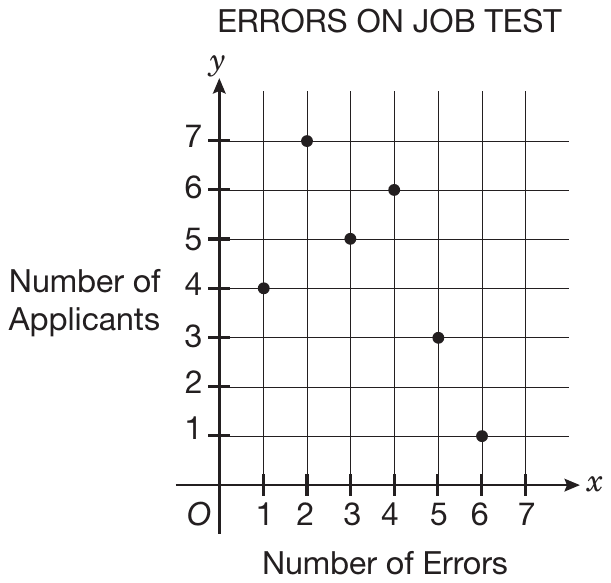
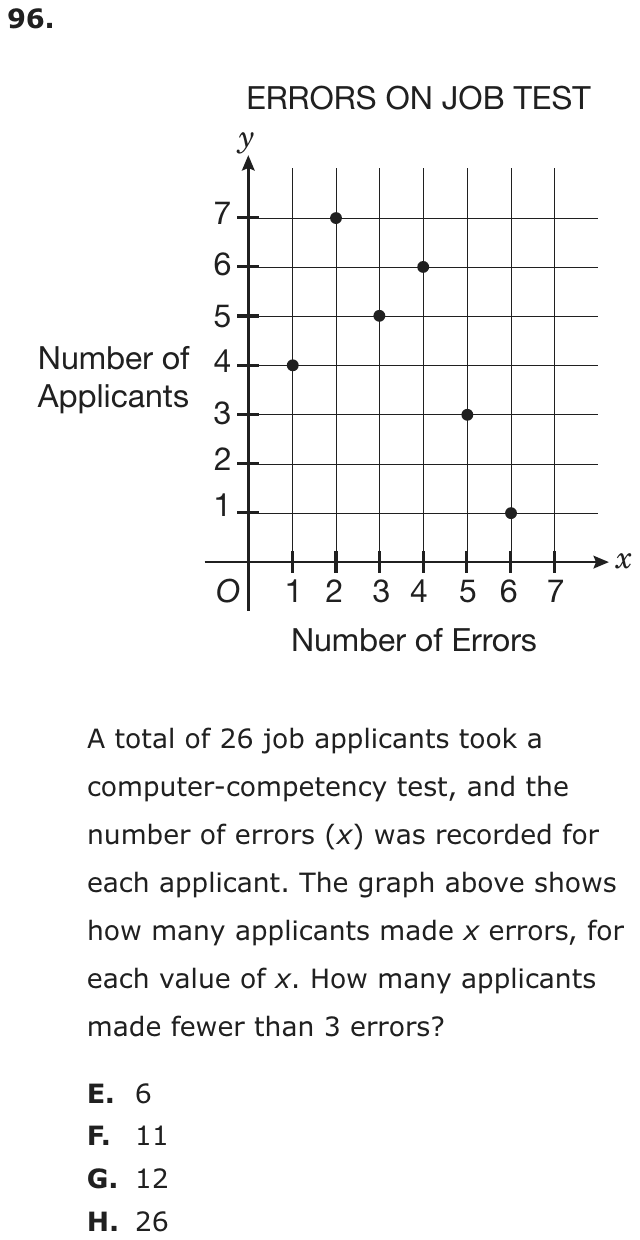
A total of 26 job applicants took a computer-competency test, and the number of errors (x) was recorded for each applicant. The graph above shows how many applicants made x errors, for each value of x. How many applicants made fewer than 3 errors?
- A6
- B11
- C12
- D26
Show the answer
Correct answer: B
Each (x, y) ordered pair represents y, the number of applicants that made x errors.
First, determine the points with x-values less than 3.
The point (1, 4) means that 4 applicants made 1 error.
The point (2, 7) means that 7 applicants made 2 errors.
Then, add the y-values to find the total applicants who made fewer than 3 errors.
Question analysis
A graph titled Errors on Job Test shows, for each number of errors, how many of 26 job applicants made that many. Students find how many applicants made fewer than 3 errors. It tests reading a data display in which each point's height is a count of people, and the words fewer than decide which points to use.
- Grade level
- Grade 6 content, by NYS standard
- Compared with grade 7
- Below grade 7 Reading counts from a data display and adding them is grade 6 statistics. It needs only a few readings from the graph and one addition, less than typical grade 7 data work, which compares distributions or uses box plots.
- Estimated difficulty
- Routine: one familiar step, little to misread.
- Thinking it demands
- Depth of knowledge 2, skills and concepts · mainly apply
- What makes it hard
- Solution
- 2 steps
- Reading level
- Question and choices: about grade 9, 42 words.
- Students, last 30 days
- Not enough answers yet to show (it takes 10).
Why it is hard, traps and wrong answers (shows the answer)
Why it is hard
This is a reading question more than a computing one: two heights from the graph and one addition. The point at 3 errors is the one to leave out, since fewer than 3 stops at 2. Checking that all six heights add up to the 26 applicants named in the stem confirms the readings before they are used.
Reading a figure, table or graph minor Understanding the question
Each point’s height is a number of applicants, so the counts for 1 and 2 errors, 4 and 7, are read on the vertical axis above those error values. (Lesh, Post & Behr, 1987; Kirsch & Mosenthal, 1990)
Turning words into math minor Understanding the question
The words “fewer than 3 errors” mean the points at 1 and 2 errors only, leaving out the 5 applicants who made exactly 3. (Hegarty, Mayer & Monk, 1995; Koedinger & Nathan, 2004)
Strategy: Read the number of applicants at each error count below 3 from the heights of the points, then add those numbers.
Traps
- Misreads the figure: Reads a value, label or tick spacing in a figure, table or graph wrongly.
- Answers a different question: A choice is right for another quantity: the other unknown, the rest instead of the part, the part instead of the whole.
The wrong answers, classified
A Misreads the figure (Lesh, Post & Behr, 1987; Kirsch & Mosenthal, 1990)
Reads the axes the wrong way round, so the one point with a height below 3, (6, 1), seems to show 6 applicants making 1 error.
C Little reason to choose it (Haladyna & Downing, 1993; Rodriguez, 2005)
No single misreading gives 12; working from the total, 26 − 15 = 11, reaches it only if a point is skipped, so it mostly draws guesses.
D Answers a different question (King et al., 2004; Hegarty, Mayer & Monk, 1995)
Gives the 26 applicants stated in the stem, everyone who took the test, instead of only those who made fewer than 3 errors.
Worked solution, step by step
Formulas used
- Reading a point
- Each point on the graph is an ordered pair. The first number, x, is read on the bottom axis: the number of errors. The second number, y, is read on the side axis: how many applicants made that many errors.
Sort out the question
In all, 26 applicants took a test. The graph shows how many made each number of errors. You need how many made “fewer than 3 errors.”
Fewer than 3 means 0, 1 or 2 errors. It does not include 3.
Read the points you need
Find the error count on the bottom axis. Then go up to the point and read across to the side axis.
- At 1 error, the point is at height 4. So 4 applicants made 1 error.
- At 2 errors, the point is at height 7. So 7 applicants made 2 errors.
There is no point at 0 errors.
Add the two counts
So 11 applicants made fewer than 3 errors.
Watch out: leave out the point at 3 errors, (3, 5). Those 5 applicants made exactly 3 errors, not fewer. Reading the axes the wrong way round can give 6, choice A. And 26 is everyone, choice D. So the answer is B, 11.
Check your answer
Add all six heights: . That is the 26 applicants in the question, so the readings are right. It also shows nobody made 0 errors. The other made 3 or more.
More questions like this
The original DOE question