Question
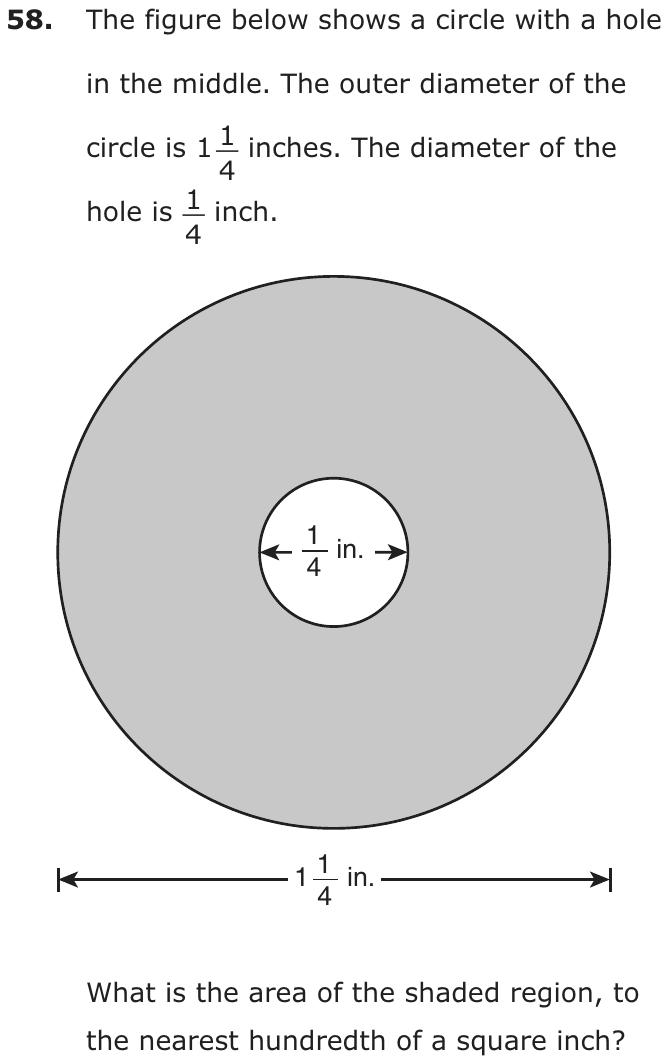
The figure below shows a circle with a hole in the middle. The outer diameter of the circle is inches. The diameter of the hole is inch.
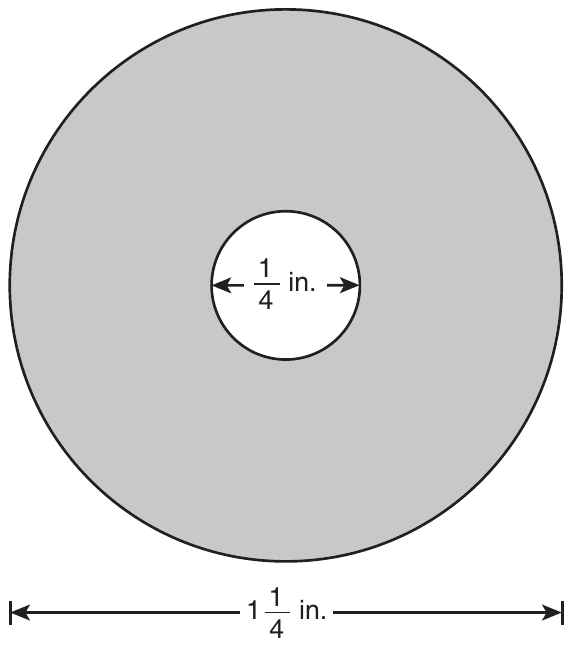
What is the area of the shaded region, to the nearest hundredth of a square inch?
Grid-in question: work out the answer and enter it as a number.
Show the answer
Correct answer: 1.18
To determine the area of a circle, begin by finding the radius of the circle, which is half of the diameter.
The radius of the entire circle is , so the area of the entire circle is
The radius of the hole in the circle is , so the area of the hole in the circle =
To determine the area of the shaded region, subtract the area of the hole in the circle from the area of the entire circle:
1.1775 square inches rounded to the nearest hundredth of a square inch = 1.18 square inches
Question analysis
A gray ring is a circle 1 1/4 inches across with a hole 1/4 inch across at its center, and this grid-in asks for the area of the shaded part to the nearest hundredth of a square inch. Students use the area of a circle twice. Turning diameters given as fractions into radii, and squaring them, is where mistakes happen.
- Grade level
- Grade 7 content, by NYS standard
- Compared with grade 7
- At grade 7 Grade 7 students find circle areas and often subtract a hole from a shape. This ring gives its diameters as a mixed number and a fraction, so halving, squaring fractions and rounding add work, though no step goes beyond grade 7.
- Estimated difficulty
- Moderate: several steps, or a close reading with one strong distractor.
- Thinking it demands
- Depth of knowledge 2, skills and concepts · mainly apply
- What makes it hard
- Something you must already know moderate
- Error-prone arithmetic moderate
- Combines ideas minor
- An answer in an unexpected form minor
- Solution
- 4 steps
- Reading level
- Question and choices: about grade 6, 45 words.
- Corrected from the DOE handbook
- A missing exponent in the explanation’s area formula was restored.
- An arithmetic slip in the explanation was corrected.
- Students, last 30 days
- Not enough answers yet to show (it takes 10).
Why it is hard, traps and wrong answers (shows the answer)
Why it is hard
The method is the familiar one for a ring, the big circle's area minus the hole's, but the labels are diameters given as fractions, so each one has to be halved and then squared before π enters. Students lose points by skipping the halving, by stopping at the full disk, or by subtracting the radii before squaring. Keeping both areas as fractions of π, 25/64π − 1/64π = 3/8π, leaves one multiplication and one rounding at the very end.
Something you must already know moderate Working it out
Neither area formula is printed, and both circles are labeled by diameter, so students must recall A = πr² and halve 1 1/4 inches and 1/4 inch to radii of 5/8 and 1/8 first. (Anderson & Krathwohl, 2001)
Error-prone arithmetic moderate Working it out
Every value is a fraction: 5/4 ÷ 2 = 5/8, squares of 25/64 and 1/64, then 3/8 × 3.14 worked by hand, so a slip can enter at each stage. (Brown & Burton, 1978; Junker & Sijtsma, 2001)
Combines ideas minor Working it out
The gray ring has no formula of its own; it is the large circle's area minus the hole's, so the area formula is used twice and the results subtracted. (Embretson, 1998; Daniel & Embretson, 2010)
An answer in an unexpected form minor Choosing the answer
The grid-in wants the nearest hundredth, so 1.1775 must be rounded to 1.18, and a whole-disk area such as 1.23 gets no warning from a list of choices. (Enright, Morley & Sheehan, 2002)
Strategy: Write 1 1/4 as 5/4 and halve both diameters to get the radii, subtract the hole's area from the area of the full circle, and round to the nearest hundredth only at the very end.
Traps
- Wrong formula: Uses a related but wrong formula: perimeter for area, diameter for radius, area for volume, or a misremembered one.
- Stops one step early: A choice is a number from partway through the solution.
- A formula you must know: Needs a formula the test does not give: area, circumference, volume, probability rules.
The wrong answers, classified
4.71 Wrong formula (King et al., 2004)
Uses the labeled diameters as radii, π(5/4)² − π(1/4)² = 24/16π = 1.5π ≈ 4.71, forgetting to halve them first, which makes the ring four times too big.
1.23 Stops one step early (King et al., 2004; Gierl et al., 2017)
Finds the area of the whole circle, π(5/8)² = 25/64π ≈ 1.23 square inches, and stops before subtracting the hole's 1/64π.
0.79 A faulty procedure (Brown & Burton, 1978; Tatsuoka, 1983)
Subtracts the radii first, 5/8 − 1/8 = 1/2, then squares, π(1/2)² ≈ 0.79, as if the difference of two squares were the square of the difference.
What was corrected from the DOE handbook, and why
- Explanation: The handbook writes the area of the whole circle as “π(5/8) in.² = 25/64π in.²” and the area of the hole as “π(1/8) in.² = 1/64π in.²” (p. 128, question 58), squaring the unit but not the radius. The area of a circle is πr², and π(5/8) is only 5/8π. The site now reads π(5/8)² in.² = 25/64π in.² and π(1/8)² in.² = 1/64π in.². The areas that follow and the answer, 1.18, are unchanged.
- Explanation: The handbook computes (3/8) in.²(3.14) as “1.175 in.²” and then rounds “1.175 square inches” to 1.18 (p. 128, question 58). But 3/8 × 3.14 = 1.1775, so the site now reads 1.1775 in both places. Rounded to the nearest hundredth it is still 1.18 square inches, the answer (with π itself, 3/8 × π = 1.178…, which also rounds to 1.18).
Worked solution, step by step
Formulas used
- Radius from diameter
- d is the diameter, the distance straight across a circle through its center. r is the radius, the distance from the center to the edge. The diameter is two radii laid end to end, so the radius is half of it.
- Area of a circle
- A is the area, the space inside the circle. π (pi) is a number a little more than 3, about 3.14. r is the radius. r² means r × r. Square the radius first, then multiply by π.
Sort out the question
The gray part is a ring. It is the big circle with the hole cut out. The big circle is inches across. The hole is inch across. These are diameters. You need the area of the gray ring, in square inches. Round it to the nearest hundredth, two places after the decimal point.
Find both radii
The area formula uses the radius, so halve each diameter first. Write the mixed number as a fraction: .
The big circle’s radius is 5/8 inch. The hole’s radius is 1/8 inch. Watch out: don’t use the diameters as radii. That makes the ring four times too big, and you would grid 4.71.
Find the area of the big circle
To square a fraction, square the top and square the bottom. The big circle’s area is 25/64 π square inches. Keep π for now. You will use 3.14 at the very end.
Find the area of the hole
The hole’s area is 1/64 π square inches. Watch out: square each radius on its own. Don’t subtract the radii first. That gives , and leads to 0.79.
Subtract the hole
The ring is the big circle minus the hole. Both fractions have 64 on the bottom, so subtract the tops.
To simplify 24/64, divide the top and bottom by 8. Watch out: don’t stop at the big circle. Its area alone is about 1.23 square inches.
Multiply by 3.14 and round
The ring’s area is 1.1775 square inches. To round to the hundredths place, look at the next digit. It is 7, which is 5 or more, so round up. 1.1775 becomes 1.18. Using the π key instead gives 1.178…, which also rounds to 1.18. So you would grid 1.18.
Check your answer
Estimate. The big circle is about 1.23 square inches. The hole is tiny: is about 0.05 square inch. . That matches. The ring must also be smaller than the whole circle, and it is.
More questions like this
The original DOE question