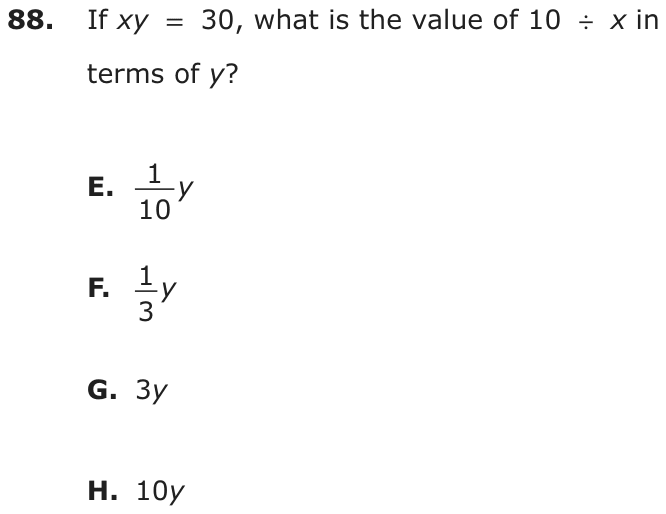
Question
If , what is the value of in terms of y?
- A
- B
- C
- D
Show the answer
Correct answer: B
Solve , the given equation, for x:
Then:
Question analysis
An algebra question: given that x times y equals 30, students express 10 divided by x using only y. It tests solving for one variable and dividing by an algebraic fraction. Working with letters instead of numbers, and dividing in the right order, are what trip students up.
- NYS standards
- Grade level
- Grade 7 content, by NYS standard
- Compared with grade 7
- At grade 7 Grade 7 students rewrite expressions that have numbers and one variable. This one links two variables through their product and asks for a quotient, with no numbers given to check an answer against.
- Estimated difficulty
- Moderate: several steps, or a close reading with one strong distractor.
- Thinking it demands
- Depth of knowledge 1, recall and reproduction · mainly apply
- What makes it hard
- Variables instead of numbers moderate
- Error-prone arithmetic minor
- A very close wrong answer minor
- Solution
- 3 steps
- Reading level
- Question and choices: about grade 7, 16 words.
- Students, last 30 days
- Not enough answers yet to show (it takes 10).
Why it is hard, traps and wrong answers (shows the answer)
Why it is hard
The algebra is three short moves, but each is a place to turn a fraction upside down: solving xy = 30 for x, dividing 10 by that fraction, and reducing 10/30. Students who reach for the bigger-over-smaller division they know from whole numbers land on 3y. Choosing two numbers with a product of 30, such as 3 and 10, and testing every choice settles the question in seconds.
Variables instead of numbers moderate Understanding the question
x and y are tied only by their product, 30, and the answer must be an expression in y, so there is no number to check unless students pick a pair such as x = 3 and y = 10. (Koedinger & Nathan, 2004; Enright, Morley & Sheehan, 2002)
Error-prone arithmetic minor Working it out
Substituting x = 30/y turns 10 ÷ x into 10 divided by a fraction, which must be flipped to 10 × y/30 and then reduced. (Brown & Burton, 1978; Junker & Sijtsma, 2001)
A very close wrong answer minor Choosing the answer
The answer, (1/3)y, and the choice 3y use the same 3, one dividing y and one multiplying it, so a student unsure whether 10 ÷ 30 or 30 ÷ 10 applies sees both. (Embretson & Wetzel, 1987; Gorin & Embretson, 2006; Ascalon et al., 2007)
Strategy: Solve xy = 30 for x, substitute that fraction into 10 ÷ x, and divide by multiplying by its reciprocal; or choose values of x and y with a product of 30 and test each choice.
Traps
- Wrong operation: Adds instead of multiplying, divides the wrong way round, turns a ratio or rate upside down, or undoes a step in the wrong direction (subtracts what should be added back).
- Misunderstands the concept: A wrong belief about a concept: that percents can be added, that area grows like length, that averages can be averaged, that a bigger denominator means a bigger fraction.
- Numbers taken from the question: Combines the numbers in the question without a model of the situation, or is simply a number that appears in the question.
The wrong answers, classified
A Numbers taken from the question (Hegarty, Mayer & Monk, 1995)
Writes the 10 from 10 ÷ x under y as one tenth of y, never using the product xy = 30 to link the two letters.
C Wrong operation (Hegarty, Mayer & Monk, 1995; King et al., 2004)
Replaces x with 30/y correctly but divides 30 by 10 instead of 10 by 30, taking the larger number over the smaller, and gets 3y.
D Misunderstands the concept (Smith, diSessa & Roschelle, 1993; De Bock et al., 1998; Ni & Zhou, 2005)
Treats dividing by x as multiplying by y, as if x and y were reciprocals, though their product is 30, not 1, which gives 10y.
Worked solution, step by step
Formulas used
- Dividing by a fraction
- a is the number you divide. b over c is the fraction you divide by: b is its top and c is its bottom. To divide by a fraction, multiply by its reciprocal, the fraction flipped upside down. For example, 6 ÷ 1/2 = 6 × 2 = 12, because 12 halves fit in 6.
Sort out the question
means x times y. So x times y is 30. You need “in terms of y.” That means your answer can use y and numbers, but no x.
Solve for x
To swap x out, first get x by itself. Divide both sides of by y.
This says x is 30 divided by y.
Put the fraction in place of x
Replace x in with this fraction.
Now use the rule for dividing by a fraction. Flip the fraction and multiply.
Simplify the fraction
Both 10 and 30 can be divided by 10.
Watch out: 10 ÷ 30 is not 3. Dividing the bigger number by the smaller one gives 3y, choice C. Also, dividing by x is not the same as multiplying by y. That only works when xy is 1, not 30. It leads to choice D.
So the answer is B, .
Check your answer
Pick numbers that multiply to 30, like x = 3 and y = 10. Then . Choice B gives . They match. Choice C would give 30, and choice D would give 100.
More questions like this
The original DOE question