Question
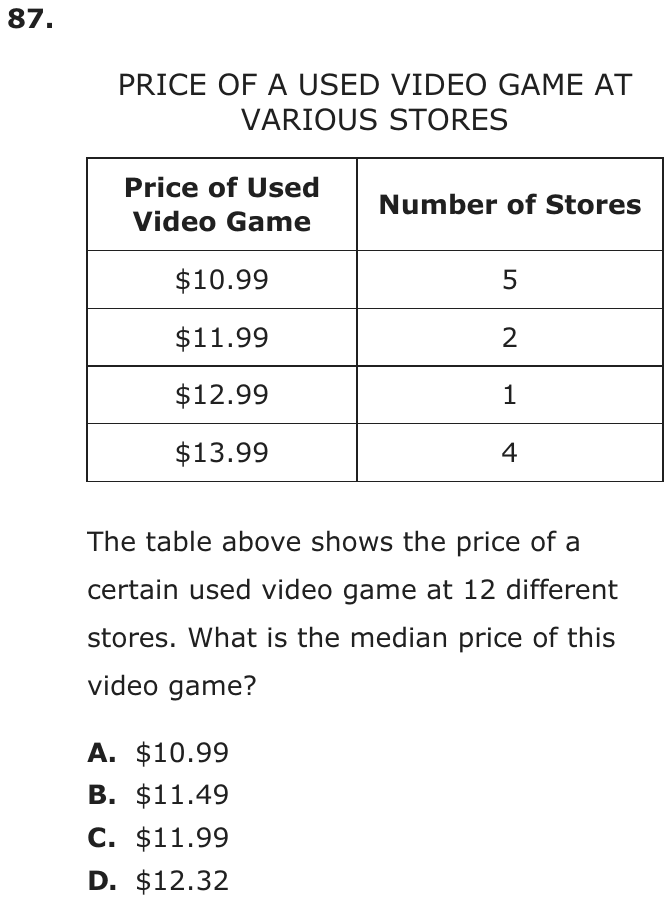
PRICE OF A USED VIDEO GAME AT VARIOUS STORES
| Price of Used Video Game | Number of Stores |
|---|---|
| $10.99 | 5 |
| $11.99 | 2 |
| $12.99 | 1 |
| $13.99 | 4 |
The table above shows the price of a certain used video game at 12 different stores. What is the median price of this video game?
- A$10.99
- B$11.49
- C$11.99
- D$12.32
Show the answer
Correct answer: C
There are 5 stores where the video game is priced at $10.99 and a total of 5 stores where it is priced at either $12.99 or $13.99, so the median price must be $11.99.
Question analysis
A statistics question with a table showing the price of a used video game at 12 stores, grouped by price, and asking for the median price. Students put the prices in order using the number of stores at each price and find the middle. The table gives counts rather than a list, so the position of the middle value has to be worked out from the running totals.
- Grade level
- Grade 6 content, by NYS standard
- Compared with grade 7
- At grade 7 Finding a median is grade 6 work that grade 7 students meet often. The twist is the frequency table: the 12 prices are not listed one by one, so students count positions instead of reading down a list.
- Estimated difficulty
- Straightforward: two steps or one careful reading.
- Thinking it demands
- Depth of knowledge 2, skills and concepts · mainly apply
- What makes it hard
- Solution
- 2 steps
- Reading level
- Question and choices: about grade 4, 40 words.
- Students, last 30 days
- Not enough answers yet to show (it takes 10).
Why it is hard, traps and wrong answers (shows the answer)
Why it is hard
The arithmetic is trivial once the positions are found: counting down 5 stores at $10.99 and then 2 at $11.99 puts both the 6th and 7th prices at $11.99. The wrong choices reward three different misreadings of a frequency table: the most common price, a middle pair one place too early, and the mean, which takes a long computation to reach. A student who writes the running totals 5, 7, 8 and 12 beside the table avoids all three.
Reading a figure, table or graph moderate Understanding the question
The 12 prices are never listed; the table gives four prices with store counts of 5, 2, 1 and 4, so the 6th and 7th prices must be found by a running count. (Lesh, Post & Behr, 1987; Kirsch & Mosenthal, 1990)
Something you must already know minor Working it out
With 12 values the median is the mean of the 6th and 7th in order, a rule the question assumes; here both fall in the $11.99 row, so no averaging is needed. (Anderson & Krathwohl, 2001)
Strategy: Keep a running total of the store counts down the table; with 12 prices in order, the median is the average of the 6th and 7th, so find the rows where they fall.
Traps
- Answers a different question: A choice is right for another quantity: the other unknown, the rest instead of the part, the part instead of the whole.
- Counting the ends: Inclusive or exclusive ends, fence posts, consecutive numbers: an answer that is one too many or too few, or an endpoint drawn open where it belongs closed (or the reverse).
The wrong answers, classified
A Answers a different question (King et al., 2004; Hegarty, Mayer & Monk, 1995)
Gives the mode, $10.99, the price that 5 stores charge, more than any other, instead of the middle price of the 12.
B Counting the ends (Brown & Burton, 1978)
Knows to average two middle prices but takes the 5th and 6th instead of the 6th and 7th, averaging $10.99 and $11.99 to get $11.49.
D Answers a different question (King et al., 2004; Hegarty, Mayer & Monk, 1995)
Computes the mean instead, $147.88 for all 12 prices divided by 12, about $12.32, a different measure of center from the median asked for.
Worked solution, step by step
Formulas used
- Median of an even number of values
- The median is the middle value when all the values are listed from least to greatest. With an even number of values, no single value sits in the middle. So take the two middle values and find their average: add them and divide by 2.
Sort out the table
Each row gives a price and how many stores charge it. For example, 5 stores charge $10.99. So $10.99 shows up 5 times in the list of prices. Add the stores to check the count.
There are 12 prices. You need the median. That is the middle price when the prices are in order from least to greatest.
Find the middle places
12 is an even number, so no single price sits in the middle. The two middle prices are the 6th and the 7th. Five prices come before the 6th one. Five prices come after the 7th one.
Count down the table
The table already lists the prices from least to greatest. Keep a running total of the stores. It shows which places in the list each price fills.
Price Stores Places in the list $10.99 5 1st to 5th $11.99 2 6th and 7th $12.99 1 8th $13.99 4 9th to 12th The 6th and 7th prices are both $11.99.
Find the median
Use the formula with the 6th and 7th prices.
The median price is $11.99.
Watch out: $10.99 is the mode, the price that shows up most often. That is choice A, not the median. Averaging the 5th and 6th prices gives $11.49, choice B. Adding all 12 prices and dividing by 12 gives the mean, about $12.32. That is choice D.
So the answer is C, $11.99.
Check your answer
Count the prices on each side of $11.99. Five stores charge less: the five at $10.99. Five stores charge more: one at $12.99 and four at $13.99. The two sides match, so $11.99 is in the middle.
More questions like this
The original DOE question