Question
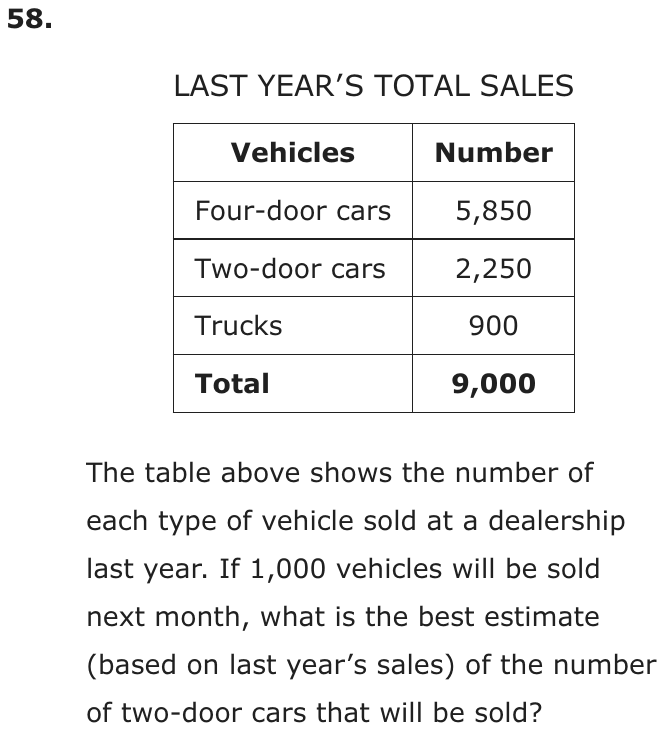
LAST YEAR’S TOTAL SALES
| Vehicles | Number |
|---|---|
| Four-door cars | 5,850 |
| Two-door cars | 2,250 |
| Trucks | 900 |
| Total | 9,000 |
The table above shows the number of each type of vehicle sold at a dealership last year. If 1,000 vehicles will be sold next month, what is the best estimate (based on last year’s sales) of the number of two-door cars that will be sold?
Grid-in question: work out the answer and enter it as a number.
Show the answer
Correct answer: 250
Let x represent the number of two-door cars that will be sold next month. Use the information in the table to set up a proportion:
Question analysis
A table shows last year's sales at a car dealership: four-door cars, two-door cars and trucks, 9,000 vehicles in all. This grid-in asks for the best estimate of how many two-door cars will be sold next month if 1,000 vehicles are sold. Students set up a proportion from the table; most of its rows are not needed.
- Grade level
- Grade 6 content, by NYS standard
- Compared with grade 7
- Below grade 7 Grade 7 proportion problems often take several steps or awkward numbers. This one scales a single share from a table to a new total, with numbers that divide cleanly, which is closer to grade 6 ratio work.
- Estimated difficulty
- Straightforward: two steps or one careful reading.
- Thinking it demands
- Depth of knowledge 2, skills and concepts · mainly apply
- What makes it hard
- Solution
- 2 steps
- Reading level
- Question and choices: about grade 4, 55 words.
- Students, last 30 days
- Not enough answers yet to show (it takes 10).
Why it is hard, traps and wrong answers (shows the answer)
Why it is hard
Once the share is seen as 2,250 out of 9,000, a quarter, the arithmetic is light, which makes this one of the easier grid-ins. Points are lost by entering the share itself as a percent, by reading the wrong row of the table, or by building a monthly average when the question supplies next month’s total. With no choices to compare, checking that the entry is a quarter of 1,000 is the only safeguard.
Turning words into math minor Understanding the question
The phrase “best estimate (based on last year’s sales)” has to become a proportion: two-door cars keep the same share of next month’s 1,000 vehicles as of last year’s 9,000. (Hegarty, Mayer & Monk, 1995; Koedinger & Nathan, 2004)
Reading a figure, table or graph minor Understanding the question
The table lists three vehicle types and a total; only the two-door row, 2,250, and the 9,000 total are needed, so the four-door and truck rows are distractions. (Lesh, Post & Behr, 1987; Kirsch & Mosenthal, 1990)
Strategy: Find what fraction of last year's 9,000 vehicles were two-door cars, simplify it, then take that fraction of the 1,000 vehicles expected next month.
Traps
- Stops one step early: A choice is a number from partway through the solution.
- Information you don't need: The question gives numbers or facts that play no part in the answer.
The wrong answers, classified
25 Stops one step early (King et al., 2004; Gierl et al., 2017)
Finds that 2,250 of 9,000 sales is 25 percent and enters that percent, stopping before taking a quarter of next month’s 1,000 vehicles.
650 Misreads the figure (Lesh, Post & Behr, 1987; Kirsch & Mosenthal, 1990)
Reads the four-door row instead of the two-door row and scales it correctly: 5,850 of 9,000 is 650 of 1,000.
187.5 Misreads the question (Hegarty, Mayer & Monk, 1995)
Divides last year’s 2,250 two-door sales by 12 months, a monthly average that ignores the stated 1,000 vehicles for next month.
Worked solution, step by step
Formulas used
- Proportion
- A proportion says two fractions are equal. Each fraction here is a part over its whole: two-door cars over all vehicles sold. Use it when a share stays the same while the total changes. Then you can find the missing part.
Sort out the question
The table shows last year’s sales. In all, 9,000 vehicles were sold, and 2,250 of them were two-door cars. Next month, 1,000 vehicles will be sold. You need about how many of them will be two-door cars.
“Based on last year’s sales” means two-door cars keep the same share of all sales. A share is a part out of a whole. The four-door and truck rows don’t matter here.
Find last year’s share of two-door cars
Last year, 2,250 out of 9,000 vehicles were two-door cars. Write that as a fraction and simplify it.
This works because . So 1 out of every 4 vehicles sold was a two-door car.
Set up the proportion and solve
Let x be the number of two-door cars next month. Next month’s share must match last year’s share.
To get x alone, multiply both sides by 1,000.
So about 250 two-door cars will be sold.
Give the answer
Watch out: one fourth is the same as 25%. Gridding 25 gives the percent, not the number of cars. Also be sure to use the two-door row. The four-door row would give 650. So you would grid 250.
Check your answer
Try it another way. Next month’s 1,000 vehicles are of last year’s 9,000. So take of the 2,250 two-door cars: . Both ways give 250 cars.
More questions like this
The original DOE question