Question
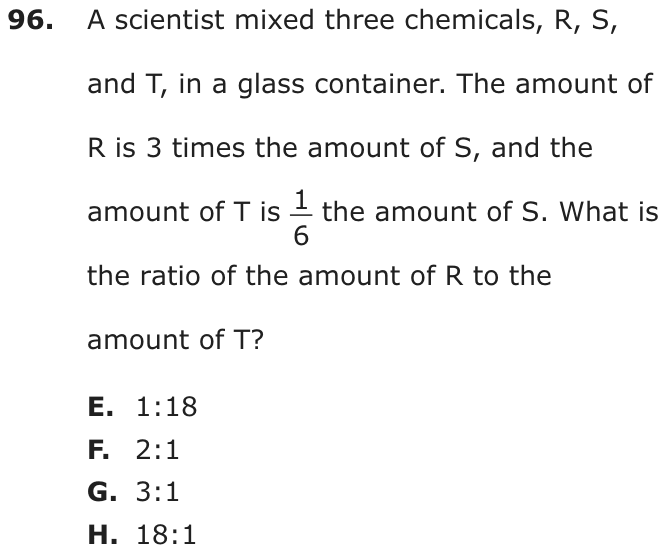
A scientist mixed three chemicals, R, S, and T, in a glass container. The amount of R is 3 times the amount of S, and the amount of T is the amount of S. What is the ratio of the amount of R to the amount of T?
- A1:18
- B2:1
- C3:1
- D18:1
Show the answer
Correct answer: D
First, set up the equations based on the information in the question.
So, the ratio of R:T is
Divide both sides by S to eliminate the variable. Then, multiply both sides by 6 to eliminate the fraction. The resulting ratio is 18:1.
Question analysis
This ratio question describes three chemicals mixed in a container: R is 3 times the amount of S, and T is one sixth of S. Students must combine the two relationships through S to find the ratio of R to T. Writing the ratio in the wrong order, or using only one of the relationships, produces the tempting wrong choices.
- Grade level
- Grade 7 content, by NYS standard
- Compared with grade 7
- At grade 7 Grade 7 ratio problems often link two quantities through a third. Here R and T are each described relative to S, one as a multiple and one as a fraction, and combining them into one ratio is typical grade 7 work with an order trap.
- Estimated difficulty
- Moderate: several steps, or a close reading with one strong distractor.
- Thinking it demands
- Depth of knowledge 2, skills and concepts · mainly apply
- What makes it hard
- Turning words into math moderate
- A very close wrong answer moderate
- Variables instead of numbers minor
- Solution
- 3 steps
- Reading level
- Question and choices: about grade 6, 48 words.
- Students, last 30 days
- Not enough answers yet to show (it takes 10).
Why it is hard, traps and wrong answers (shows the answer)
Why it is hard
The question chains two comparisons through S, and the 1/6 makes the chain awkward to do with letters. Choosing S = 6 turns it into whole numbers at once. The listed wrong ratios come from writing the right numbers in the wrong order, combining 3 and 6 by division, or stopping at the first comparison. Rereading which amount the question names first settles the order.
Turning words into math moderate Understanding the question
Both sentences compare a chemical with S, R as 3 times S and T as 1/6 of S, so S must serve as the link before R can be compared with T. (Hegarty, Mayer & Monk, 1995; Koedinger & Nathan, 2004)
A very close wrong answer moderate Choosing the answer
The ratios 1:18 and 18:1 use the same two numbers in opposite order, so only checking that R, the larger amount, comes first separates the right ratio from its reverse. (Embretson & Wetzel, 1987; Gorin & Embretson, 2006; Ascalon et al., 2007)
Variables instead of numbers minor Understanding the question
No amounts are given, only relationships, so students either reason with S as a letter or choose a number for it, such as 6, which makes R 18 and T 1. (Koedinger & Nathan, 2004; Enright, Morley & Sheehan, 2002)
Strategy: Pick a convenient amount for S, such as 6, so that both R and T come out as whole numbers, then write R to T in that order and simplify.
Traps
- Wrong operation: Adds instead of multiplying, divides the wrong way round, turns a ratio or rate upside down, or undoes a step in the wrong direction (subtracts what should be added back).
- Answers a different question: A choice is right for another quantity: the other unknown, the rest instead of the part, the part instead of the whole.
The wrong answers, classified
A Wrong operation (Hegarty, Mayer & Monk, 1995; King et al., 2004)
Works out the amounts correctly but writes the ratio upside down, T to R, putting the smaller amount first.
B Wrong operation (Hegarty, Mayer & Monk, 1995; King et al., 2004)
Divides the 6 by the 3 instead of multiplying them, combining the two comparisons with S the wrong way to get 2:1.
C Answers a different question (King et al., 2004; Hegarty, Mayer & Monk, 1995)
Uses only the first sentence, R is 3 times S, and gives the ratio of R to S instead of R to T.
Worked solution, step by step
Formulas used
- Equal ratios
- a and b are two amounts being compared, and n is any number except 0. Multiplying or dividing both parts of a ratio by the same number gives an equal ratio. For example, 2 : 1 is the same as 4 : 2.
Sort out the question
There are three chemicals, R, S and T. R is 3 times S. T is of S. You need the ratio of R to T, written R : T. Both facts compare a chemical with S, so S links R and T.
Pick an easy amount for S
No amounts are given, so you may choose one. Pick 6 units for S, because 6 divides evenly by 6.
So R is 18 units and T is 1 unit.
Write the ratio of R to T
R comes first because the question asks for R to T. Watch out: writing it the other way round gives 1:18, choice A. Using only the first fact gives R : S = 3 : 1, choice C.
Check with letters instead
Without picking a number, R = 3S and T is . Divide both parts by S, then multiply both parts by 6.
So the answer is D, 18:1.
Check your answer
R should be much bigger than T. R is 3 times S, while T is only a small piece of S. Try another amount, S = 12. Then R = 36 and T = 2, and 36 : 2 is also 18 : 1.
More questions like this
The original DOE question