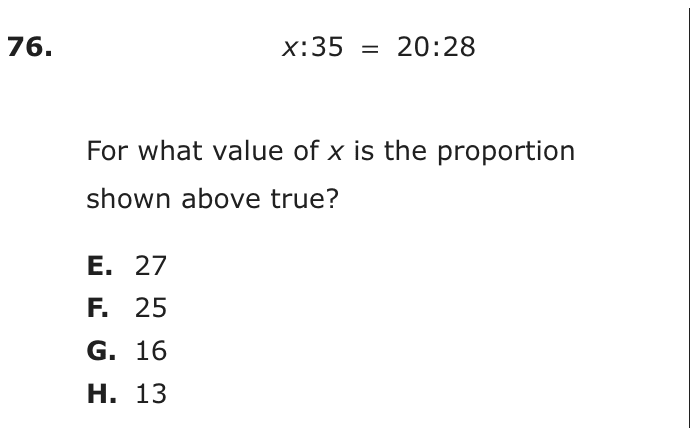
Question
For what value of x is the proportion shown above true?
- A27
- B25
- C16
- D13
Show the answer
Correct answer: B
Write the ratios in fraction form and solve for x:
| Cross multiply. | |
| Apply the multiplicative inverse property; divide both sides by 28. | |
Question analysis
This question gives the proportion x:35 = 20:28 and asks for the value of x that makes it true. Students use equivalent ratios or cross-multiplication. The trap is reasoning by adding or subtracting the difference between terms rather than multiplying, which gives numbers that look reasonable but break the ratio.
- Grade level
- Grade 6 content, by NYS standard
- Compared with grade 7
- Below grade 7 Finding a missing term in a proportion is grade 6 ratio reasoning, and here the given ratio simplifies to small numbers. It is easier than typical grade 7 proportional reasoning, which usually involves fractions or a real context.
- Estimated difficulty
- Routine: one familiar step, little to misread.
- Thinking it demands
- Depth of knowledge 1, recall and reproduction · mainly apply
- What makes it hard
- Error-prone arithmetic minor
- A very close wrong answer minor
- Solution
- 2 steps
- Reading level
- Question and choices: about grade 5, 12 words.
- Students, last 30 days
- Not enough answers yet to show (it takes 10).
Why it is hard, traps and wrong answers (shows the answer)
Why it is hard
This is a single proportion with whole numbers, and the only real trap is reasoning by differences instead of by a common factor. Since 35 is 7 more than 28, adding or subtracting 7 to 20 is tempting, but equal ratios scale; they do not shift. Reducing 20:28 to 5:7 shows at once that the scale factor to 35 is 5.
Error-prone arithmetic minor Working it out
Cross-multiplying gives 28x = 700, and 700 ÷ 28 is not a table fact; simplifying 20:28 to 5:7 first turns it into 5 × 5. (Brown & Burton, 1978; Junker & Sijtsma, 2001)
A very close wrong answer minor Choosing the answer
27 is only 2 more than 25, so a rough sense that x is a little more than 20 fits both; only the exact scale factor, 35/28 = 5/4, separates them. (Embretson & Wetzel, 1987; Gorin & Embretson, 2006; Ascalon et al., 2007)
Strategy: Simplify 20:28 to lowest terms first, then scale it up so its second term becomes 35, or cross-multiply and divide by 28.
Traps
- Misunderstands the concept: A wrong belief about a concept: that percents can be added, that area grows like length, that averages can be averaged, that a bigger denominator means a bigger fraction.
- Wrong operation: Adds instead of multiplying, divides the wrong way round, turns a ratio or rate upside down, or undoes a step in the wrong direction (subtracts what should be added back).
The wrong answers, classified
A Misunderstands the concept (Smith, diSessa & Roschelle, 1993; De Bock et al., 1998; Ni & Zhou, 2005)
Reasons with differences: since 35 is 7 more than 28, adds 7 to 20, keeping the gap between the terms instead of their ratio.
C Wrong operation (Hegarty, Mayer & Monk, 1995; King et al., 2004)
Scales 20 by 28/35 instead of 35/28, so 20 × 28 ÷ 35 = 16, which turns the ratio of the second terms upside down.
D Misunderstands the concept (Smith, diSessa & Roschelle, 1993; De Bock et al., 1998; Ni & Zhou, 2005)
Reasons with differences and also goes the wrong way, subtracting 7 from 20, though x must exceed 20 because 35 exceeds 28.
Worked solution, step by step
Formulas used
- Ratio as a fraction
- a:b is a ratio, read a to b. It compares two amounts by division. You can write it as the fraction a over b. Two equal ratios make a proportion.
- Equivalent fractions
- a over b is a fraction, and k is any number except 0. Multiplying or dividing the top and the bottom by the same number gives an equal fraction.
Sort out the question
is a proportion. A proportion says two ratios are equal. A ratio compares two numbers, like 20 to 28. You need the value of x that makes the two ratios equal.
Write the ratios as fractions
Write each ratio as a fraction. The first number of the ratio goes on top. The second goes on the bottom.
Simplify the known fraction
20 and 28 both divide by 4. Smaller numbers are easier to work with.
So now .
Scale up so the bottom is 35
7 times 5 is 35. To keep the fraction equal, multiply the top by 5 too.
So x = 25. Watch out: a ratio is about multiplying, not adding. 35 is 7 more than 28, but adding 7 to 20 gives 27, choice A. Also, x must be more than 20, because 35 is more than 28. So 16 and 13 are too small. So the answer is B, 25.
Check your answer
Cross-multiply, as the test’s own explanation does. and . The two products are equal, so the ratios 25:35 and 20:28 are equal.
More questions like this
The original DOE question